Yes, denim can shrink in the dryer, particularly when it is wet and exposed to a high-temperature or excessively long drying cycle. However, the amount of shrinkage depends on the fabric composition, whether the denim was pre-shrunk, the washing temperature and the dryer setting.
Raw or unsanforized denim has the greatest shrinkage risk. Most modern pre-shrunk jeans may change only slightly, while stretch denim can lose its shape or elasticity when repeatedly exposed to high heat.
Quick answer: Denim may shrink in the dryer, especially when it contains a high percentage of cotton. To protect the original fit, check the care label, wash the garment in cold water and air-dry it. When machine drying is necessary, choose a short low-heat or no-heat cycle and remove the denim before it becomes overdried.
Does Denim Really Shrink in the Dryer?
Denim can shrink during laundering because moisture, agitation and drying allow the fabric structure to relax and change dimensions. High-temperature drying and overdrying can make that change more noticeable, particularly in cotton-rich denim.
The dryer is not always the only cause. A hot wash, an intensive washing cycle and a heated dryer can work together to produce more shrinkage than either process would create on its own. Whirlpool recommends using cold water and low drying heat to reduce shrinkage in cotton garments.
The amount of change also depends on how the denim was manufactured. Some jeans are treated or prewashed to improve dimensional stability before they reach the customer. Others, such as raw or shrink-to-fit jeans, have not received the same level of pre-shrinking treatment.
Can Dry Denim Shrink in the Dryer Without Washing?
Completely dry jeans are less likely to shrink dramatically than wet jeans because moisture plays an important role in allowing the fabric structure to relax. However, placing dry denim in a hot dryer can still affect its texture, colour and fit, especially when the cycle is long or repeated frequently.
When you only want to refresh jeans, use an air-only, no-heat or very low-heat setting. A hot cycle is unnecessary for removing mild odours or softening jeans that have already been dried.
Do not assume that a dry pair of jeans cannot be damaged. Repeated high-temperature drying may contribute to fading, stiffness, surface wear and reduced elasticity in stretch denim.
Do Jeans Shrink After One Dryer Cycle?
Jeans can feel tighter after a single wash-and-dry cycle, particularly when they are new, made from 100% cotton or have not been pre-shrunk.
The first cycle often produces the most noticeable change because the fabric is relaxing from the tension created during manufacturing. Pre-shrunk jeans are generally more stable, but “pre-shrunk” does not necessarily mean completely shrink-proof.
Levi’s states that most of its regular jeans are pre-shrunk and should not shrink significantly. The company still recommends cold washing and line drying to minimise dimensional change.
How Much Does Denim Shrink in the Dryer?
There is no single percentage that applies to every denim garment. Shrinkage depends on:
- Cotton percentage
- Fabric construction
- Manufacturing treatments
- Washing temperature
- Dryer temperature
- Cycle duration
- The garment’s previous wash history
- Whether the denim contains elastane or synthetic fibres
As a general reference, Clorox estimates that common jeans may shrink by up to approximately 3–4%. On jeans with a 32-inch inseam, that could represent around 1 to 1¼ inches of lost length. This is not a guarantee, and raw denim may behave very differently.
| Denim type | Likely response to machine drying | Relative shrinkage risk |
|---|---|---|
| Pre-shrunk denim | Usually changes slightly | Low to moderate |
| 100% cotton denim | More responsive to laundering conditions | Moderate to high |
| Raw or unsanforized denim | May shrink noticeably during early washes | High |
| Stretch denim | May tighten slightly, but heat can affect elasticity | Moderate |
| Cotton-polyester denim | Often more dimensionally stable | Low to moderate |
| Denim jackets and skirts | Depends on fabric, lining and construction | Variable |
Always treat these descriptions as general guidance. The care label and the manufacturer’s instructions should take priority.
How Many Inches Can Jeans Shrink?
The number of inches lost depends on the original measurements and the percentage of dimensional change.
For example:
| Original measurement | 3% change | 4% change |
|---|---|---|
| 30-inch inseam | 0.9 inches | 1.2 inches |
| 32-inch inseam | 0.96 inches | 1.28 inches |
| 34-inch inseam | 1.02 inches | 1.36 inches |
These calculations illustrate why a small percentage can still create a noticeable fit problem. A loss of approximately one inch in the inseam may be significant, even when the percentage appears low.
Do Jeans Shrink More in Length or Waist?
Shrinkage is not always uniform. The inseam or overall leg length may show a more obvious change because even a small percentage reduction is easy to notice along a long measurement.
The waistband, thighs, rise and leg opening can also tighten. However, the waist and knees may loosen again as the jeans are worn and move with the body. Lost length is generally harder to recover through normal wear.
Seams, thread tension, pockets and waistbands can influence how the garment changes. This is why one area may feel tighter while another appears almost unchanged.
Can Jeans Shrink One or Two Full Sizes?
Some untreated cotton denim may shrink substantially, but trying to reduce ordinary pre-shrunk jeans by one or two complete sizes is unreliable.
Excessive heat may create uneven results, including:
- Excessive inseam loss
- A tight rise
- Twisted seams
- Uneven leg openings
- Colour fading
- A damaged waistband
- Reduced stretch recovery
When jeans need a precise size reduction, professional alteration is usually more predictable than repeated hot washing and drying.
Do Jeans Shrink More in the Washer or Dryer?
Both the washer and dryer can contribute to denim shrinkage.
A hot wash introduces heat, moisture and agitation. The dryer then removes moisture while adding tumbling and, depending on the setting, more heat. Combining an intensive hot wash with a high-temperature dryer usually creates a greater risk than using a cold gentle wash followed by air drying.
Whirlpool identifies heat and agitation as major factors in cotton garment shrinkage and recommends gentler cold-water washing with low-temperature drying.
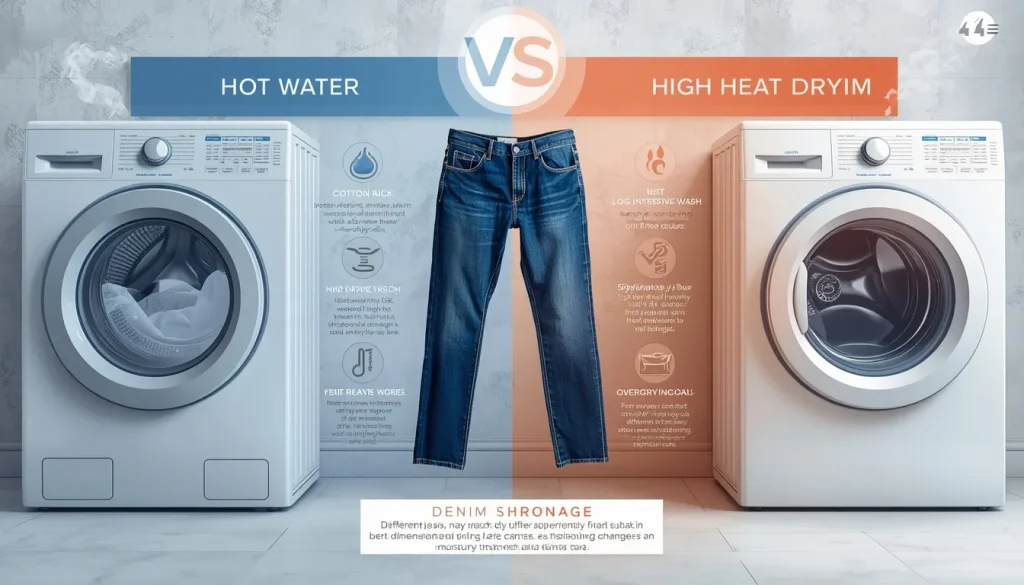
Hot-Water Washing vs High-Heat Drying
Hot water can encourage fabric relaxation during washing. High dryer heat may then set or intensify the resulting dimensional change as the wet garment dries.
That does not mean every hot wash or dryer cycle will produce the same result. Two pairs of jeans can react differently because of their fibre content, weave, finishing treatment and previous care.
The highest-risk combination is generally:
- A cotton-rich or untreated denim garment
- A hot, intensive wash
- A long high-heat drying cycle
- Continued drying after the garment is already dry
Does Cold Washing Prevent Denim Shrinkage?
Cold washing does not guarantee zero shrinkage, but it reduces one of the main risk factors and is commonly recommended by denim manufacturers.
Levi’s advises washing denim in cold water, turning jeans inside out and air drying. Wrangler also recommends cold washing and air drying to protect fit and colour.
Cold water can also help dark denim retain its colour. New dark jeans should usually be washed separately or with similar colours because excess dye may transfer during early washes.
What Dryer Temperature Shrinks Denim?
There is no universal temperature that will produce a precise amount of shrinkage. Dryer settings and actual operating temperatures vary by appliance, load size and cycle type.
The safest approach is to think in terms of relative risk:
| Dryer setting | Expected effect | Recommended use |
|---|---|---|
| Air only or no heat | Lowest shrinkage risk | Refreshing or finishing partially air-dried jeans |
| Low heat | Lower but not zero risk | When machine drying is necessary |
| Medium heat | Greater chance of dimensional change | Only when permitted by the care label |
| High heat | Highest shrinkage and damage risk | Usually avoid for fit preservation |
| Extended overdrying | Can increase stiffness, fading and wear | Avoid |
In the USA and Canada, appliance instructions commonly use the word “dryer.” In the UK and Australia, the same appliance is often called a “tumble dryer.” Both terms refer to the same general drying process.
Does Denim Shrink on Low Heat?
Denim can still shrink slightly on low heat, especially if it is new, wet, cotton-rich or untreated. However, low heat is normally less aggressive than medium or high heat.
Many jeans that permit machine drying specify “tumble dry low” on the care label. The label remains more important than general internet advice because it reflects the garment’s fabric, dye, trims and construction.
What Does “Tumble Dry Low” Mean for Jeans?
A square containing a circle is the standard symbol for tumble drying. Dots inside the symbol indicate the permitted drying intensity. A crossed-out tumble-dryer symbol means the garment should not be tumble dried.
“Tumble dry low” generally means using a mild drying process with reduced thermal action. It does not mean that every low-temperature dryer cycle is identical, so check your appliance manual when necessary.
Air Dry vs Tumble Dry Jeans
Air drying is the safer option when your main goals are preserving the fit, reducing colour loss and avoiding unnecessary heat exposure.
Tumble drying is faster and may leave denim feeling softer, but it increases the possibility of shrinkage and fading. A useful compromise is to run a short low-heat cycle, remove the jeans while they are slightly damp, reshape them and allow them to finish drying naturally.
Levi’s and Wrangler both recommend air drying as part of their denim-care guidance.
Which Types of Denim Shrink the Most?
The word “denim” covers many fabrics. Two garments that look similar may respond very differently in the laundry.
100% Cotton Denim
Rigid 100% cotton jeans usually have a higher shrinkage risk than jeans containing polyester or another dimensionally stable synthetic fibre.
Cotton-rich denim may also relax and stretch during wear, particularly around the waist, knees and seat. This means jeans can feel tight immediately after washing but become more comfortable after several hours of use.
Raw or Unsanforized Denim
Raw denim has received little or no washing after dyeing and construction. Unsanforized denim has not gone through the mechanical pre-shrinking process commonly used to improve dimensional stability.
This category requires the greatest care because early washing or soaking may significantly affect the fit. Levi’s recommends cold hand washing, avoiding wringing and air drying raw denim.
Follow the individual brand’s sizing and care instructions rather than applying a generic method to expensive raw denim.
Pre-Shrunk or Sanforized Denim
Pre-shrunk or sanforized denim has been processed to reduce future dimensional change. It may still shrink slightly, particularly after repeated hot washes or heated drying, but the result is usually less dramatic than with untreated denim.
The term “pre-shrunk” should be understood as “more dimensionally stable,” not “incapable of shrinking.”
Does Selvedge Denim Shrink?
Selvedge describes the self-finished edge produced by certain weaving methods. It does not automatically tell you whether the denim is raw, washed, sanforized or unsanforized.
A sanforized pair of selvedge jeans may shrink only slightly. An unsanforized pair may change much more. Check the product description for both terms before washing.
Does Stretch Denim Shrink?
Stretch denim normally combines cotton with elastane, spandex or another stretch fibre. It may tighten slightly after washing, but repeated high heat can be more harmful to its elasticity than beneficial to its fit.
When stretch fibres deteriorate, jeans may lose recovery and become loose, distorted or uneven rather than fitting better. Use cold water and low heat or air drying unless the care label states otherwise.
Do Black Jeans Shrink or Fade in the Dryer?
Black jeans can shrink when their fibre composition and construction make them susceptible to dimensional change. They are also vulnerable to visible fading.
To protect black denim:
- Turn it inside out
- Wash it in cold water
- Use a gentle cycle
- Wash it with other dark garments
- Avoid unnecessary dryer heat
- Air-dry it away from intense direct sunlight
Levi’s recommends inside-out cold washing and air drying to preserve darker denim.
Do New Jeans Shrink After the First Wash and Dry?
New jeans may shrink during their first wash and dry, but the amount depends heavily on their treatment.
Prewashed or pre-shrunk jeans are designed to remain relatively stable. Raw, shrink-to-fit or unsanforized jeans may undergo a more significant change.
New dark denim can also release excess dye during its first wash. Washing it separately, turning it inside out and using cold water can help prevent dye transfer and unnecessary fading.
Do Jeans Shrink Every Time?
Jeans do not normally shrink by the same amount during every laundry cycle. The most noticeable dimensional change often occurs during the first few washes, especially in untreated cotton denim.
Later cycles may produce smaller changes. However, continued exposure to high heat can still affect colour, texture, seams and stretch fibres even when the jeans no longer appear to be getting smaller.
When Do Jeans Stop Shrinking?
There is no exact number of washes that applies to every pair. Many jeans become more dimensionally stable after their early wash-and-dry cycles, but their long-term behaviour depends on the fabric and care routine.
Jeans may also tighten after washing and loosen again during wear. This temporary change should not always be confused with permanent shrinkage.
How to Dry Jeans Without Shrinking Them
Use the following method when preserving the original size and shape is the priority.
1. Read the Care Label
Before washing, check:
- Fibre composition
- Recommended water temperature
- Permitted dryer setting
- Whether tumble drying is prohibited
- Special instructions for coatings, patches or embellishments
The care label considers more than the main fabric. Buttons, zips, finishes, dyes and decorative elements can all affect the recommended treatment.
2. Turn the Jeans Inside Out
Turning jeans inside out reduces direct friction against the visible surface. It can help preserve dark dye, printed details and the appearance of high-friction areas.
Fasten buttons and zips before washing so they do not catch on other garments.
3. Wash in Cold Water
Select cold water and a gentle or denim-appropriate cycle. Avoid overloading the machine because garments need enough room to move and rinse properly.
Wash dark denim with similar colours, particularly during its first few washes.
4. Remove Excess Water Gently
Do not aggressively twist or wring wet denim. Instead, allow the washing machine to complete an appropriate spin cycle or gently press the garment in a clean towel.
5. Reshape the Denim While Damp
Straighten the legs, align the seams and gently reshape the waistband. For a denim jacket, reshape the sleeves, collar and front panels.
Avoid aggressive pulling, which may distort the garment.
6. Air-Dry the Garment
Hang jeans by the waistband or lay them flat in a well-ventilated area. Keep very dark denim away from intense direct sunlight when colour retention is important.
Air drying is widely recommended by major denim brands as a way to protect fit and colour.
7. Use Low Heat Only When Necessary
When air drying is not practical:
- Select a low-heat or no-heat setting.
- Use a shorter cycle than usual.
- Remove the jeans while slightly damp.
- Straighten the seams and waistband.
- Finish drying them naturally.
How to Intentionally Shrink Jeans in the Dryer
It is possible to encourage some shrinkage by using warmer washing and drying conditions, but the result is difficult to control.
Before attempting it, check the care label and fabric composition. Do not use this method on expensive raw denim, coated denim, heavily embellished garments or jeans that already fit correctly in length.
How to Shrink an Entire Pair of Jeans
A cautious method is:
- Measure the waist, inseam and thigh before washing.
- Wash the jeans using a warmer setting only when the care label permits it.
- Place them in the dryer using a heated cycle.
- Check the jeans regularly rather than overdrying them.
- Allow them to cool before evaluating the final fit.
Levi’s describes hot washing followed by heated drying as a way to shrink ordinary cotton jeans. The company also warns through its wider care guidance that cold washing and air drying are preferable when the goal is to prevent shrinkage.
How Long Should Jeans Stay in the Dryer to Shrink?
There is no reliable universal time because dryer performance, moisture level, fabric weight and garment construction vary.
Start with a short cycle and inspect the jeans regularly. Continuing the cycle until the fabric becomes extremely hot and overdried may create more damage than useful shrinkage.
Remember that jeans can continue to feel different after cooling. Do not judge the fit while the fabric is still hot.
Can You Shrink Only the Waist or Legs?
Targeted shrinking is possible, but the result is usually subtle and temporary.
Lightly dampen the area you want to tighten, apply controlled heat and allow the section to dry. Protect leather patches, printed details, elastic sections and decorative elements.
For a precise waist, thigh or leg adjustment, tailoring is a more dependable solution.
Risks of Intentionally Shrinking Denim
Intentional shrinking may cause:
- Uneven dimensional change
- Excessive inseam loss
- Twisted side seams
- Colour fading
- A rough or stiff texture
- Damaged elastane
- Distorted pockets
- An uncomfortable rise
Never assume heat will reduce every part of the garment proportionally.
Is Dryer Shrinkage Permanent?
Some shrinkage can be permanent, while some tightness may relax during wear.
Cotton jeans often loosen around areas exposed to movement and body pressure, such as the waistband, knees and seat. However, lost inseam length may be difficult to recover.
Stretch denim may not return to its original shape if excessive heat has damaged the elastic fibres. In that situation, the problem is fibre deterioration rather than simple temporary contraction.
How to Unshrink Jeans After Dryer Damage
Slightly shrunken jeans may sometimes be relaxed, but no method guarantees complete restoration.
Dampen and Gently Stretch the Jeans
- Place the jeans on a clean, flat surface.
- Spray the tight area with lukewarm water.
- Gently pull the fabric in the direction that needs more room.
- Hold the stretch briefly without forcing the seams.
- Allow the jeans to air-dry while maintaining the corrected shape.
Wear the Jeans While Slightly Damp
When the jeans are only mildly tight and still comfortable enough to wear:
- Dampen the waistband, thighs or knees.
- Put the jeans on carefully.
- Walk, sit and bend gently.
- Remove them if the seams feel overstressed.
- Let them finish air drying.
Do not use this method when the jeans restrict circulation, cause pain or are difficult to fasten.
Soak and Reshape the Denim
For more general tightness, soak the jeans briefly in lukewarm water, remove excess water without wringing and reshape them on a flat surface.
This may help relax minor dimensional change. It is less likely to repair severe heat damage or restore broken elastane fibres.
When Unshrinking May Not Work
Recovery may be limited when:
- The inseam has shortened substantially
- The jeans were severely overdried
- The side seams have twisted
- Stretch fibres have deteriorated
- The waistband structure has become distorted
- The fabric has been repeatedly exposed to high heat
Common Denim-Drying Mistakes to Avoid
Ignoring the Care Label
A method that works for basic cotton jeans may damage coated, stretch, raw or embellished denim.
Automatically Selecting High Heat
High heat is rarely necessary for routine denim drying and increases the risk of shrinkage, fading and overdrying.
Leaving Jeans in the Dryer Too Long
Continuing the cycle after the jeans are already dry can make the fabric stiff and increase unnecessary wear.
Drying Stretch Jeans on High Heat
Stretch denim requires particular care because its elastic fibres may deteriorate under repeated thermal stress.
Washing Jeans With Heavy Towels
Heavy towels can increase friction and extend drying time. Wash and dry denim with garments of a similar weight whenever practical.
Trying to Shrink Jeans by Multiple Sizes
Machine drying cannot provide the precision of tailoring. The waist, thighs and length may not shrink equally.
Treating Raw and Pre-Shrunk Denim the Same Way
Raw or unsanforized denim requires more careful brand-specific guidance than ordinary pre-shrunk jeans.
Quick Denim Drying Guide
| Your goal | Recommended method |
|---|---|
| Preserve the original fit | Cold wash and air-dry |
| Dry jeans more quickly | Short low-heat cycle followed by air drying |
| Protect dark colour | Turn inside out, cold wash and dry away from intense sun |
| Protect stretch denim | Avoid high heat and overdrying |
| Slightly tighten loose jeans | Use controlled heat and check the fit frequently |
| Care for raw denim | Follow the manufacturer’s instructions |
| Restore mildly shrunken jeans | Dampen, reshape and air-dry |
| Refresh dry jeans | Use an air-only or no-heat cycle |
Frequently Asked Questions
Will 100% Cotton Denim Shrink in the Dryer?
Yes. Cotton-rich denim has a greater shrinkage risk than many denim blends, especially when it is wet and dried at a high temperature. Pre-shrinking treatments may reduce the amount of change but cannot always eliminate it.
Does Denim Shrink on Low Heat?
It can shrink slightly on low heat, but the risk is generally lower than with medium or high heat. Use a short cycle and remove the denim while slightly damp when preserving the fit is important.
Does Denim Shrink Without Washing?
Dry denim may tighten slightly after a hot dryer cycle, but the result is normally less predictable and less dramatic than drying wet denim. Repeated heat can still cause fading, stiffness and fabric damage.
Do Jeans Shrink More in the Washer or Dryer?
Both can contribute. Hot water and agitation affect the fabric during washing, while heated tumbling affects it during drying. Combining a hot wash with a high-heat dryer creates the greatest risk.
How Many Inches Can Jeans Shrink in the Dryer?
Common jeans may lose around one inch of length when they experience approximately 3–4% shrinkage, but the result varies widely. Raw denim can change more, while pre-shrunk blends may change less.
Do Pre-Shrunk Jeans Still Shrink?
Yes, they can still shrink slightly. Pre-shrinking improves dimensional stability but does not necessarily make the garment completely shrink-proof.
Do Stretch Jeans Shrink in the Dryer?
Stretch jeans may tighten temporarily, but high heat can also weaken elastane or spandex. Air drying or low-temperature drying is usually the safer option.
Does Raw Denim Shrink More Than Regular Denim?
Raw or unsanforized denim generally has a higher potential for shrinkage because it has not received the same pre-shrinking treatment as most ordinary retail jeans.
Can Jeans Shrink by One Full Size?
Some untreated cotton jeans may shrink substantially, but reducing ordinary pre-shrunk jeans by exactly one size is unreliable. Alteration is more predictable when a precise result is needed.
Can I Put Dry Jeans in the Dryer to Shrink Them?
You can, but completely dry jeans may not shrink evenly or significantly. Lightly damp denim usually responds more than fully dry denim, although heat still creates a risk of fading and damage.
Will Jeans Stretch Back Out After Shrinking?
The waistband, seat and knees may loosen during wear. Lost length and severe heat damage are less likely to recover fully.
How Can I Dry Jeans Quickly Without Shrinking Them?
Use a short low-heat cycle, remove the jeans while slightly damp, reshape them and finish drying them in a ventilated area.
Can a Denim Jacket Shrink in the Dryer?
Yes. Cotton denim jackets may shrink when exposed to hot water or a heated dryer. Whirlpool recommends cold water and hang drying to reduce the risk.
Is Tumble Drying the Same as Using a Dryer?
Yes. “Tumble dryer” is the term commonly used in the UK and Australia, while “dryer” is more common in the USA and Canada.
What Is the Safest Dryer Setting for Denim?
An air-only or no-heat setting presents the lowest shrinkage risk. When heat is necessary and the care label permits machine drying, choose a short low-heat cycle.
Final Verdict
Does denim shrink in the dryer? Yes, it can—but the amount depends on the denim type, fibre content, manufacturing treatment and laundry settings.
Raw, unsanforized and 100% cotton denim generally have the highest shrinkage risk. Pre-shrunk jeans are more stable, while stretch jeans require protection from high heat because their elastic fibres may become damaged.
The safest routine is simple: read the care label, turn the garment inside out, wash it in cold water, reshape it while damp and air-dry it. When a tumble dryer is necessary, use low or no heat, keep the cycle short and remove the denim before it becomes overdried.
That approach helps protect the size, shape, colour and long-term comfort of your jeans.

Oliver Bennett is a home appliance writer specializing in washer and dryer solutions, laundry care, and energy-efficient appliances. He provides detailed reviews, buying guides, and maintenance tips to help users choose reliable machines and achieve better laundry results.