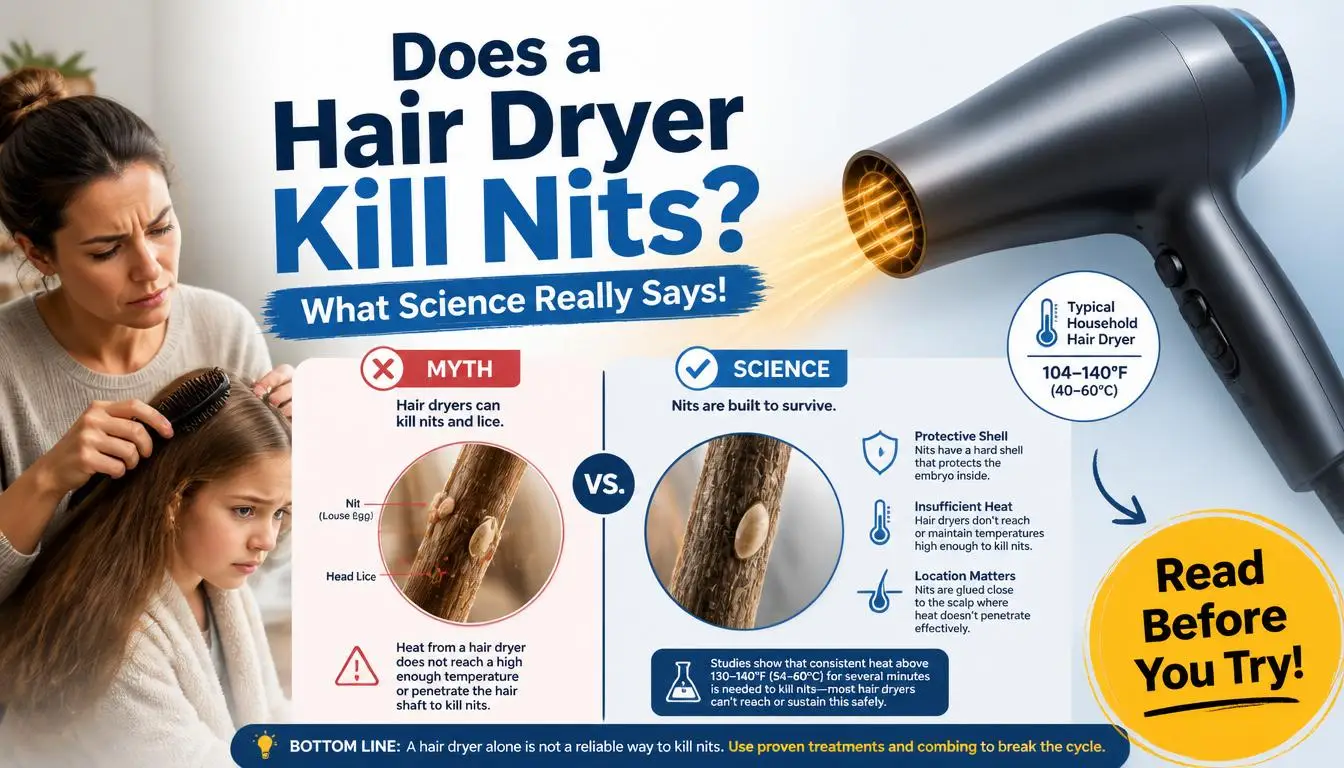
Quick Answer: No, a regular hair dryer does not reliably kill nits (lice eggs). While hot air may dehydrate or weaken some live lice, nits are protected by a hard outer shell that helps them survive the temperatures produced by most household hair dryers. The most effective way to eliminate a head lice infestation is to combine an approved lice treatment with careful nit combing and follow-up care.
Head lice are one of the most common concerns for parents, caregivers, teachers, and anyone living in close-contact environments. When someone discovers nits attached to hair strands, the first thought is often whether a simple household appliance, like a hair dryer can solve the problem. After all, heat kills many insects, so it seems logical to assume that hot air might also destroy lice eggs.
Unfortunately, the answer isn’t that simple. While heat can affect head lice under certain conditions, the temperatures and airflow produced by a standard hair dryer are usually not enough to eliminate nits safely or consistently. Relying solely on a blow dryer may leave eggs behind, allowing the infestation to continue.
In this guide, you’ll learn how nits survive, whether heat actually works, why hair dryers aren’t recommended as a primary treatment, and the safest, most effective methods for getting rid of head lice for good.
Expert Insight: Successful lice treatment isn’t about finding a quick shortcut, it’s about breaking the lice life cycle by removing both live lice and their eggs.
What Are Nits?
Before discussing whether a hair dryer can kill nits, it’s important to understand exactly what nits are.
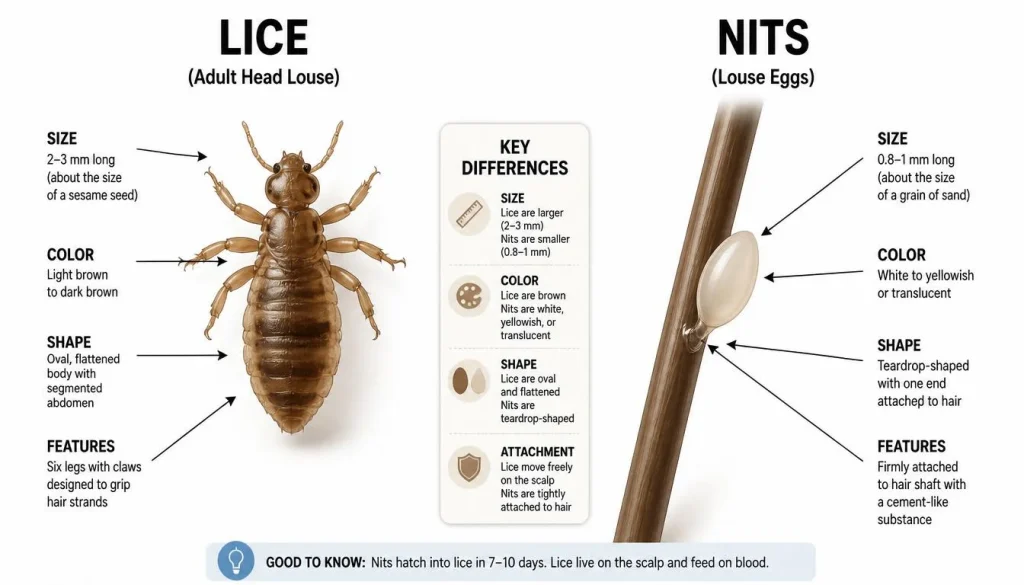
Nits are the tiny eggs laid by adult female head lice. These eggs are firmly attached to individual hair shafts using a strong, glue-like substance that makes them difficult to remove with regular brushing or washing.
Unlike dandruff, nits don’t easily fall off the hair. They remain attached until they hatch or are manually removed with a fine-toothed nit comb.
Difference Between Lice and Nits
| Feature | Live Lice | Nits |
|---|---|---|
| What they are | Crawling insects | Lice eggs |
| Movement | Yes | No |
| Color | Gray, brown, or tan | White, yellow, or brown |
| Easy to remove | Sometimes | No |
| Can reproduce | Yes | Not until they hatch |
Understanding this difference is essential because treatments that kill live lice may not always destroy the eggs.
Does a Hair Dryer Kill Nits?
The short answer is no.
A standard household hair dryer is not considered a reliable method for killing nits.
Here’s why:
- Nits have a tough protective shell.
- They are glued close to the scalp, where temperatures remain relatively stable.
- Household hair dryers don’t deliver consistent heat to every hair strand.
- Most people can’t safely expose the scalp to extremely hot air long enough to damage the eggs.
Even if some areas become hot enough, many nits remain untouched because hair creates natural insulation.
As a result, surviving eggs can hatch within several days, restarting the infestation.
Why Nits Are Difficult to Kill
Nits evolved to protect developing lice embryos.
Their outer shell helps shield them from:
- Mild heat
- Water
- Shampoo
- Everyday environmental changes
This is why removing nits usually requires a combination of approved treatments and careful combing rather than heat alone.
Do Nits Survive Heat?
Yes, under most everyday conditions.
Many people assume that because heat damages insects, it should also destroy lice eggs. However, nits are surprisingly resilient.
Several factors help them survive:
- Their protective outer casing
- Their attachment close to the scalp
- Uneven airflow from home hair dryers
- Short exposure times
Although extremely high temperatures can eventually damage lice eggs, reaching those temperatures safely with a home hair dryer is neither practical nor recommended.
Simply blow drying your hair after washing is unlikely to eliminate every nit.
Can Heat Kill Head Lice?
Heat can kill head lice under controlled conditions.
Professional lice treatment clinics sometimes use specialized heated-air devices designed specifically for lice removal. These machines deliver carefully controlled airflow and temperature that gradually dehydrate lice and reduce egg survival.
However, these devices are very different from an ordinary hair dryer.
Professional systems are designed to:
- Produce controlled airflow
- Maintain safe treatment temperatures
- Reach the entire scalp evenly
- Reduce the risk of burns
A household blow dryer cannot consistently achieve these conditions.
Therefore, while heat itself can affect lice, that doesn’t mean a regular hair dryer is an effective treatment.
What Temperature Kills Lice and Nits?
Temperature plays an important role in controlling insects, but simply making hair feel hot isn’t enough.
To affect lice and their eggs, heat generally must:
- Reach sufficiently high temperatures
- Be maintained for an adequate amount of time
- Contact every affected area evenly
Household hair dryers vary widely in temperature depending on:
- Distance from the scalp
- Heat setting
- Hair thickness
- Airflow speed
- Room conditions
Because of these variables, it’s impossible to guarantee that every nit receives enough heat to be destroyed.
Attempting to increase effectiveness by holding the dryer very close to the scalp also increases the risk of:
- Skin burns
- Scalp irritation
- Hair damage
- Overheating
For these reasons, medical professionals generally recommend proven lice treatments instead of relying on household heat.
Does a Hair Dryer Kill Live Lice?
A hair dryer may affect live lice differently than it affects nits.
Moving hot air may:
- Dry out some lice
- Slow their movement temporarily
- Blow crawling lice away from one area
However, these effects are inconsistent.
Many live lice survive because they:
- Quickly move deeper into the hair
- Stay close to the scalp
- Avoid direct airflow
Even worse, surviving female lice can continue laying eggs.
This means you might think the infestation is improving while dozens of nits remain attached to the hair.
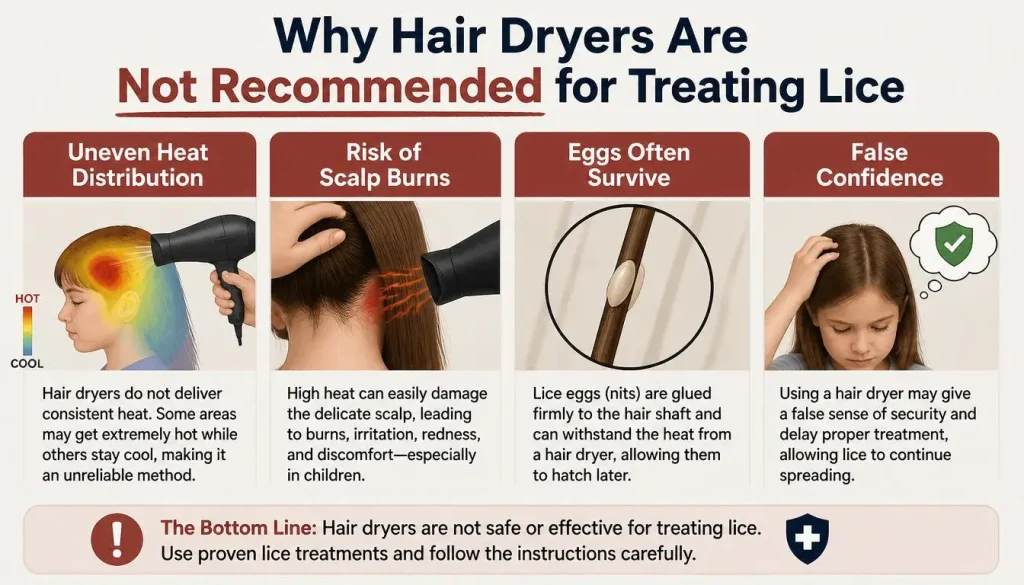
Why Hair Dryers Are Not Recommended for Treating Lice
Although using a hair dryer sounds like a simple home remedy, experts generally advise against relying on it as the primary treatment.
Here are the biggest reasons.
Uneven Heat Distribution
Hair creates multiple layers.
The outer strands receive most of the hot air, while inner sections remain much cooler.
As a result, many nits never experience enough heat to be affected.
Risk of Scalp Burns
Keeping a hot dryer close to the scalp for extended periods increases the risk of:
- Redness
- Burns
- Skin irritation
- Discomfort, especially for children
Eggs Often Survive
Even if some live lice die, surviving nits continue the infestation.
Within about a week, newly hatched lice begin feeding and the entire cycle starts again.
False Confidence
One of the biggest problems is believing the infestation has been eliminated.
Without proper combing and follow-up treatment, remaining eggs often hatch unnoticed.
Professional Heat Treatments vs. Hair Dryers
Many people confuse professional heated-air lice treatments with ordinary blow dryers.
The two are very different.
| Feature | Household Hair Dryer | Professional Heated-Air Treatment |
|---|---|---|
| Designed for lice removal | No | Yes |
| Temperature control | Limited | Precise |
| Airflow consistency | Variable | Controlled |
| Even scalp coverage | No | Much better |
| Reliability against nits | Poor | Higher when properly performed |
| Burn risk | Higher if misused | Lower under trained supervision |
Professional treatments should still be combined with proper follow-up and nit removal, but they are significantly more effective than attempting to use a standard hair dryer at home.
How Long Would You Need to Use a Hair Dryer?
Some people wonder whether using a blow dryer for 20, 30, or even 45 minutes would improve the results.
The answer is still no.
Longer drying sessions do not guarantee that every nit will receive enough heat.
Instead, prolonged exposure mainly increases the risk of:
- Dry hair
- Scalp discomfort
- Skin burns
- Heat damage to the hair shaft
More importantly, surviving eggs can still hatch days later.
Time alone cannot compensate for the limitations of a household hair dryer.
What Actually Kills Nits?
If a hair dryer isn’t the answer, what actually works?
The most successful approach combines an effective lice treatment with careful manual removal of nits. No single method is perfect on its own, which is why health professionals often recommend a combination of treatments to break the lice life cycle.
| Treatment Method | Kills Live Lice | Kills Nits | Recommended |
|---|---|---|---|
| Household Hair Dryer | ❌ | ❌ | No |
| Fine-Toothed Nit Comb | ✅ (with repeated combing) | ✅ | Yes |
| OTC Lice Shampoo | ✅ | Sometimes | Yes |
| Prescription Lice Medication | ✅ | Often | Yes (when needed) |
| Dimethicone-Based Treatment | ✅ | Limited | Yes |
| Professional Heated-Air Treatment | ✅ | More Effective | Yes |
The key is consistency. Even the best treatment may require a second application several days later to eliminate newly hatched lice before they mature.
Step-by-Step: The Best Way to Get Rid of Nits
Follow these steps to improve your chances of completely eliminating head lice.
Step 1: Confirm It’s Head Lice
Before beginning treatment, make sure you’re dealing with an actual lice infestation rather than dandruff, hair casts, or product buildup.
Look for:
- Live crawling lice
- Oval-shaped nits firmly attached to the hair
- Itching around the scalp and neck
Step 2: Apply an Approved Lice Treatment
Use an over-the-counter or prescription product according to the manufacturer’s instructions.
Never combine multiple treatments unless advised by a healthcare professional.
Step 3: Comb Out Every Nit
Use a high-quality metal nit comb.
Work in small sections and comb from the scalp to the ends of the hair.
Wipe the comb after every pass.
This step is often the most important because remaining eggs can hatch later.
Step 4: Repeat Treatment If Needed
Many products recommend repeating treatment about 7–10 days later.
This helps eliminate lice that hatch after the first application.
Step 5: Clean Personal Items
Although head lice spread mainly through direct head-to-head contact, it’s still helpful to clean items that recently touched the hair.
These include:
- Pillowcases
- Hats
- Hair brushes
- Hair accessories
- Bedding
- Recently worn clothing
Can Hot Air Make Lice Worse?
Not exactly—but it can create problems.
Hot air doesn’t usually increase the number of lice, but it may:
- Cause lice to move to cooler areas of the scalp
- Blow live lice into different sections of the hair
- Give the impression that the infestation is gone when eggs remain
This false sense of success often delays proper treatment, allowing the infestation to continue.
Can You Use a Hair Dryer After Applying Lice Shampoo?
This depends on the product you’re using.
Some lice treatments include ingredients that should not be exposed to high heat immediately after application.
Always:
- Read the product label carefully.
- Follow the manufacturer’s instructions.
- Avoid using high heat unless the instructions specifically allow it.
If you’re unsure, allow the treatment to work as directed before styling the hair
How to Prevent Nits from Coming Back
Successfully treating lice is only part of the solution. Preventing reinfestation is equally important.
Here are several practical steps:
- Check all household members if one person has lice.
- Avoid sharing combs, brushes, hats, and hair accessories.
- Continue checking the scalp for at least two weeks.
- Wash recently used bedding and clothing.
- Soak combs and brushes in hot water according to care recommendations.
- Repeat nit combing every few days until no live lice or new nits are found.
Early detection can prevent another full infestation.
Common Myths About Killing Nits
Many home remedies circulate online, but not all of them are supported by evidence.
| Myth | Fact |
|---|---|
| A hair dryer kills all nits. | Household hair dryers are not reliable. |
| Vinegar dissolves every nit. | It may loosen some residue but doesn’t reliably kill nits. |
| Mayonnaise suffocates lice permanently. | Evidence is limited and inconsistent. |
| Coconut oil completely eliminates lice. | It is not considered a proven standalone treatment. |
| Hair straighteners remove all nits. | Only hairs directly exposed to high heat may be affected, and scalp safety is a concern. |
| One treatment is always enough. | Many infestations require follow-up treatment and repeated combing. |
Separating myths from facts helps you choose methods that are both safer and more effective.
When Should You See a Doctor?
Most head lice infestations can be managed at home, but medical advice is recommended if:
- Multiple treatments have failed.
- The infestation keeps returning.
- The scalp becomes swollen, painful, or infected.
- The affected person is very young.
- You’re unsure whether you’re dealing with lice or another scalp condition.
A healthcare provider can confirm the diagnosis and recommend the most appropriate treatment.
Expert Tip
The biggest mistake people make is focusing only on killing live lice.
Nits are what allow an infestation to continue. Even if every visible louse disappears, surviving eggs can hatch within days.
The most successful approach combines:
- An approved lice treatment
- Thorough nit combing
- Follow-up treatment when recommended
- Regular scalp checks
Patience and consistency are far more effective than relying on household heat alone.
Frequently Asked Questions
Does a hair dryer kill lice instantly?
No. A regular household hair dryer cannot reliably kill all live lice or their eggs.
Can hot air kill lice eggs?
Extreme, controlled heat may affect lice eggs, but the hot air from a standard hair dryer is generally not sufficient to eliminate them consistently.
What temperature kills lice and nits?
Lice and their eggs require sustained exposure to high temperatures under controlled conditions. Household hair dryers cannot consistently provide those conditions safely.
Does blow drying prevent head lice?
No. Blow drying your hair does not prevent lice infestations or stop lice from spreading through head-to-head contact.
Can a hair straightener kill nits?
A hair straightener may expose some hairs to high temperatures, but it cannot safely reach every nit near the scalp and should not be relied upon as a treatment.
Are professional heated-air lice treatments effective?
Yes. Professional heated-air systems are specifically designed for lice removal and are generally much more effective than ordinary hair dryers when performed correctly.
What is the fastest way to get rid of nits?
The fastest and most reliable approach is to use an approved lice treatment, thoroughly remove nits with a fine-toothed comb, and repeat treatment if recommended to break the lice life cycle.
Conclusion
So, does a hair dryer kill nits? The evidence suggests that the answer is no. While hot air may temporarily affect some live lice, a standard household hair dryer does not generate the consistent heat and airflow needed to destroy nits safely or reliably.
Instead of depending on a blow dryer, use proven lice treatments, remove nits with a quality nit comb, and follow the recommended treatment schedule. This combination offers the best chance of eliminating both live lice and their eggs while reducing the risk of reinfestation.
By understanding how nits survive and choosing evidence-based treatments, you can protect yourself and your family from recurring head lice infestations with greater confidence.

Oliver Bennett is a home appliance writer specializing in washer and dryer solutions, laundry care, and energy-efficient appliances. He provides detailed reviews, buying guides, and maintenance tips to help users choose reliable machines and achieve better laundry results.